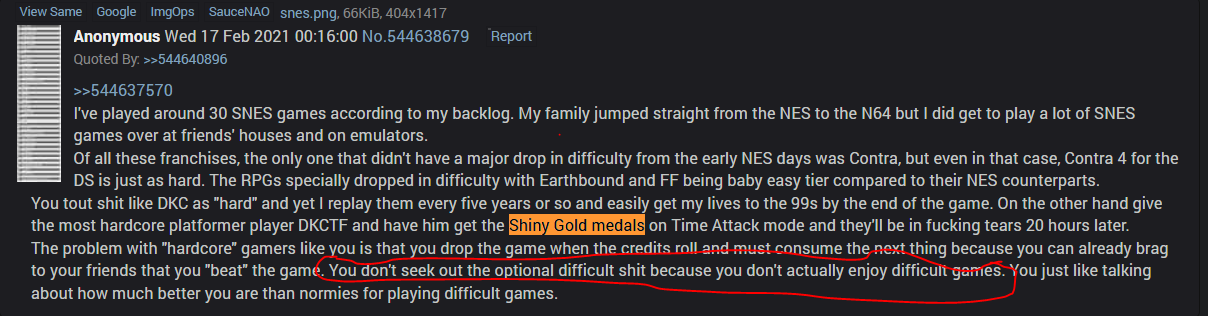
Somebody on /vr/ is absolutely desperate for attention and dug up some post from the /vr/ archives about seeking challenge. You can tell they’ve been trying to make this thread work for a while because they’ve got a ctrl-f highlight in the screenshot, a red oval around the inflammatory remark about challenge, and a red dot between the paragraphs so the image was unique (i.e., the thread they made sunk to the last page but didn’t get pruned since /vr/ is a naturally slow board).
The main point the true OP (from 2021) is that there’s a sizable audience of people who play “difficult” games not for the thrill of the difficulty itself but for the social clout of having done so as a way to separate themselves from the average gamer. Funny irony is that the OP of the most recent thread does little more than seek attention for the social clout of what appears to be someone else (???) setting an in-game record for a level of Donkey Kong Country.
Despite the basic argumentation in the thread, I think seeking challenge is interesting philosophically, even though philosophically might be too loaded of a word.
Challenge is important
Seeking challenge is how you improve yourself. For video games, it’s mostly around improving dexterity, studying systems, and coming up with ways to thrive within them. It works the hands and such, which is nice, but most importantly it forces you to think. We’ve all seen various internet posts and articles about how the brain is a muscle, and it’s very true; the more you challenge you brain the stronger it becomes, and if you don’t use it, you lose it.
Playing system-heavy video games that you like encourages you to think up and test strategies, learn about the mechanics of the game, and go through practice routines of any required mechanical skills. Much like various skill-based and creative crafts, it’s keeping you sharp by making you stay on your toes, look for new goals, and think about how to achieve them.
What’s nice these days is that this line of thinking isn’t really heretical anymore. The “thinking and development” portions of video games are held to some esteem; in the public eye, Minecraft has changed how parents and children interact with video games as something that isn’t solely a “junk food” activity. Among experienced gamers, entire genres like Roguelikes (i.e., ToME, ADOM, Barony) and Strategy (Age of Empires, Total War) continue to encourage gamers to learn, practice, and overcome.
I think one thing that’s often not mentioned about seeking challenge is that it genuinely does separate people from “the herd”. The desire to take on a tough task and overcome it is surprisingly rare; even just for regular games without player-versus-player competition, take a look at some of the Steam achievements for games out there. Personal example, I’m in the top ~4% of gamers for Metal Gear Solid 5: Ground Zeroes just because I wanted to see everything the Ground Zeroes demo had to offer. For Warhammer 40k Boltgun, I’m in the top 1.7% because I cleared the expansion pack on Hard. These are just Steam achievements as well; there’s stuff like Retroachievements and platformer leaderboards that I don’t even think about!
What’s cool about looking for challenge from video games and taking their gameplay seriously is that it connects you with like-minded people. It acts like a social sieve, where going for things like “100% completion”, joining competitive leagues and pick-up games for team-based fps games, and going to events and joining tournaments for fighting and RTS games puts you several notches above the average gaming audience. You’re actively self-selecting as a doer, an explorer, an adventurer versus being a passive content consumer.
I think seeking challenge from a game is a great way to go from being a passive “fandom” member to actually figuring out if you like the game itself, because challenge is both flexible and can scale with you. For someone who considers themselves just a fandom member, their big break or challenge could be PvE team games in Age of Empires, or games against the SimSim bot in Street Fighter 6. It’s how you dodge the feeling of having “lowkey missed out on everything”.
Challenge is different for everyone
I think one thing that gets lost in discussions is the human/individual element (this tends to happen a lot in general). Video games, at least “older” ones, tend to attract those competent enough to do other challenging things. Occasionally, the other challenging things they do are more taxing in one form or another or aren’t aligned with video games: those who are exceptional at sports, visual arts like drawing and photography, music, etc. The OP in the image makes what I’ve long considered to be a fatal mistake: assigning challenge to the narrow category of rote execution.
Challenge can take different forms for different people. There are people who aren’t deeply infatuated by games who don’t seek to push their reactions to their maximum, but want an intellectual challenge that they can take at a reasonable pace. Some people really like the tense and unforgiving nature of the odds being stacked against them. Others seek to overcome great obstacles via teamwork and communication. Still others enjoy the depth that can only be provided by squaring up against another person.
It’s really unreasonable to assail all those who play for challenge by No True Scotsman-ing the notion of challenge. The enjoyment an individual gets out of a game is critical for them to figure out how much time they’re really going to sink into one, regardless of the difficulty of various challenges in the game. Some people really fuck with Donkey Kong Country and really do want to go for the Shiny Gold medals on Time Attack mode and there’s nothing wrong with that. Other people would rather just enjoy the thrill of basic to intermediate platforming skills to see the main game to the end and nothing more; I was one of those people when I played Donkey Kong Country Returns on my 3DS, and then my ass went right back to doing competitive game soulsearching after my 6s TF2 retirement.
People who enjoy difficulty from games don’t always enjoy the same difficulty you do. For example, I highly doubt both the image’s OP or the OP of the more recent thread would last a week playing Quake 3 CPMA, 6v6 TF2, or laddering past Gold League in StarCraft 2. Personally, I’ve done a few playthroughs of Dark Souls 1 but never put myself through the ringer of that game’s PvP or did a “no damage taken” run; Dark Souls is still a challenging experience when approached for the first time.
We seek out the “optional difficult shit” when we really enjoy the specific game we’re playing, not because we “don’t enjoy difficult games”. Going back to the Metal Gear Solid: Ground Zeroes demo for MGS5 I mentioned earlier, I sought out all of the optional difficult shit in it because I loved how the movement, gunplay, and stealth felt. I loved Team Fortress 2 so much I spent over a decade playing it both casually like everyone else and competitively in both pay-to-play and free-to-play leagues. I loved how Tribes: Ascend felt during the closed beta and went on to play in one of the most prolific fights of my life.
Challenge is opinionated
I will say that, by nature, some types of challenge are inherently more shallow than others. The happy positivity sunshine-and-rainbows stuff fades away when you start comparing the intensity, breadth, and depth of the challenges various games offer. Stardew Valley and Animal Crossing have a lot of mental challenge in aesthetics and planning, but the mechanical complexity and interactivity of the gameplay in both of those games is really minimal and there’s only so much you can do. That’s fine! They’re inherently not challenging games but people find ways to push their creative limits in calm settings in those games.
Like I said earlier, people who enjoy difficulty don’t always enjoy the same difficulty you do, and will also have similar thoughts on what kinds of challenge are more shallow than others. Personal example, I do not think speedrunning is very deep; there’s initial complexity in figuring out how to go through the name quickly and normally, then there’s this deep dive of “DOOM humping” various geometry in the game being speedran to see how the speedrunner can shave seconds off consecutive runs. It devolves into an exercise in rote memorization and avoids the main gameplay loop of the game in question. Interestingly, there was some bickering in the thread about this very viewpoint, so I don’t think it’s a terribly uncommon opinion. It is an opinion nonetheless, as others think the exact opposite.
When I was playing 6v6 Team Fortress 2, people balked at the idea of the game they played for fun being taken seriously. I have a friend to this day who is infuriated by Demoman’s sticky bombs and always whips out the pubber lingo of “winbombs” when the game comes up in conversation, irony being that they’ve been nerfed several times in meaningful ways over the life of Team Fortress 2. This friend is also very good at other multiplayer games we’ve played together and is always in the top percentile with me as we play. It’s all opinions at the end of the day because it really does boil down to our experiences with a game and how much time we’re really interested in putting into that game.
In the same line of thought as the image, I think there’s a certain level of value in at least trying some of the challenge activities that you may not like, because that’s sorta the magic of video games as a whole. You never know what’s gonna surprise you or who it’ll introduce you to.
Balance in all things
At the end of the day, we all have a limited amount of time and energy in our lives. Adults maybe get 4 hours on average during the week that’s just time to themselves to pursue their interests; between work, chores, family, and other responsibilities, time just gets sucked away. I think that’s a part of where the mentality of “I am an adult, I will no longer play video games” stems from, but I think this also applies to children and students as well. There’s a huge world out there full of crazy things to do, and maybe video games are that thing you end up loving, but time marches onward and life will hit hard if you didn’t buck up during that period and explore.

Some things are extremely challenging but have no reward outside of a dopamine hit. If you’re someone who seeks challenge, you have to know when it’s fine to go “nah this ain’t it” if you aren’t absolutely infatuated with the various challenges a game can offer you. In my opinion, challenge should lead somewhere and enrich your life. Getting the Shiny Gold medals on Time Attack is great if it has personal meaning to you, but do you really want to piss away your life playing Hell Let Loose just to reach Career Level 450? Are you really locked in on the idea of maintaining the world-record tool assisted scrimblo glitch speedrun of Banjo-Kazooie by grinding runs over and over again just to find ways to shave singular seconds off your best time?
A personal example is that playing Team Fortress 2, 6v6 or otherwise, was not only an interesting and fun challenge with highs and lows, but it connected me with amazing people and even decided my career path. Almost everyone I met or knew playing 6v6 TF2 has had continued success in their life, even though more trying times. I created a lot of incredible memories both in-game and out from my relationships in TF2 and it’s because I said “why not?” to progressively challenging things.
An external example would be all the high-level fighting game players I’ve seen that have been able to pivot from game to game and develop sources of income from teaching others the nuances of fighting games at a competitive level. They’ve developed their skills, created rivalries and friendships, have built up presence on the internet via streaming and video content; it’s all consecutive challenges that they’ve taken on, and their drive rewarded them both through various life experiences and financial gain.
Getting the Shiny Gold medals in Time Attack should, at minimum, mean something to you. It should be something that makes you feel like a god, something that becomes a part of your history. It shouldn’t be a social cudgel you use against others, and it shouldn’t dominate your life; you wouldn’t want to be the modern video game equivalent of the high-school football champ whose life peaked in his last big game, would you?
Division within unity
One of the fucked up things about seeking challenge bringing people together is also how easy it is for challenge to push people apart. Credit where it’s due, I think the post in the image has a fair point buried within it; people who brag about choosing “challenging” games for the sake of saying they’re a “hardcore gamer” are vying for social prestige versus actual enjoyment. For communities built around video games (i.e., /v/, /vr/), it ends up creating a never-ending cycle of goalpost movement: those who play “hardcore” games end up shaping all future discussion because games that aren’t “hardcore” are for outsiders, and the community must be better than the outsiders.
Specifically for player-versus-player or cooperative endeavors, there are strong barriers between skill levels, but it varies from game to game. The happy path is that the experience of seeking a challenge from video games is shared among the group’s peers equally; they’re the daredevils who see the vision in the sport and practice of a given game. For my time in 6v6 Team Fortress 2, there was always a pretty strict divide between skill levels via league level. It was easy to socialize with better players via pick-up games and deathmatch, which was a huge boon, but it was very difficult to move the needle for your team if everyone wasn’t committed to the same level. You either had to schmooze and get in with a team above your level, get a higher-rated player to play for your lower-rated team and hope their experience and connections could elevate your team, or put in a shitton of work that may or may not be possible depending on everyone’s schedules.
For fighting games, I’ve noticed this divide is even harsher and more exclusionary considering the relatively extremely low population of players who do go to offline events, online tournaments, and take the genre seriously in general; the article “The Loneliness of the Low Ranking Tennis Player” describes this phenomenon in fighting games very well.
Closing thoughts
Seeking challenge in general, not just in video games, is important for keeping a sharp mind and helping you cultivate a social circle of motivated fellows. However, do not forget the golden rule of have fun. Seek challenge for the right reasons, and seek challenge that makes you a better version of you.
We all have limited time, so if you truly enjoy something and want to push it to the next level, do it and cultivate it. Maybe good aesthetic farm and house design in Stardew Valley is your challenge and calling. Despite my personal opinion, if speedrunning is that challenging thing for you, go for it. Conversely, if you feel satisfied just breezing through platformers without doing any of the “hard” stuff, that’s fine too. Anyone who holds some “shiny gold” time attack medal over you as a social cudgel sucks as a person anyway, fuck ‘em.